Thursday, July 30, 2015

Rangkaian Kiprok Sepeda Motor (Shunt Regulator)


ref:
Single phase voltage regulator (full wave)

Artikel ini menyambung artikel sebelumnya tentang kiprok honda tiger. Link di bawah ini menarik untuk dipelajari.
 
Link1 (alter)
Link2
Link3
Link4


Friday, January 3, 2014

Passing two dimensional array

#include
#include

foo(char in[][10]){
char *a = "Hello";
char *b = "Helle";

memcpy(in[0],a,strlen(a)+1);
memcpy(in[1],b,strlen(b)+1);
}


int main(int argc, char *argv[]){
char var[2][10];

  foo(var);
  printf("out: %s %s \n", var[0], var[1]);
 
    return(0);
}

Thursday, November 28, 2013

NTP Client

Linux version

#include <sys/socket.h>
#include <sys/types.h>
#include <netinet/in.h>
#include <netdb.h>
#include <stdio.h>
#include <string.h>
#include <stdlib.h>
#include <unistd.h>
#include <errno.h>
#include <arpa/inet.h >

int main(void)
{
    int sockfd = 0, n = 0, ii = 1;
    char recvBuff[1024];
    struct sockaddr_in serv_addr; 
    setvbuf(stdout, NULL, _IONBF, 0);
printf("Retrieving time, please wait ");
    memset(recvBuff, '0',sizeof(recvBuff));
    n=-1;

    while(n<=0)
    {
//    printf("====== attempt %d \n\n", ii);
    printf(".");
    
    if (ii == 50)
    {
   printf("\n");
   ii =0;
   }
    
    if((sockfd = socket(AF_INET, SOCK_STREAM, 0)) < 0)
    {
        printf("\n Error : Could not create socket \n");
        return 1;
    } 

    serv_addr.sin_addr.s_addr = inet_addr("64.90.182.55");
//     serv_addr.sin_addr.s_addr = inet_addr("96.47.67.105");
    serv_addr.sin_family = AF_INET;
    serv_addr.sin_port = htons(13); 

       if( connect(sockfd, (struct sockaddr *)&serv_addr, sizeof(serv_addr)) < 0)
       {
          printf("\n Error : Connect Failed \n");
          return 1;
       } 

       n = read(sockfd, recvBuff, sizeof(recvBuff)-1);
       close(sockfd);
       usleep(10000);
       ii++;
    }
      recvBuff[n] = 0;
      printf("%s\n",recvBuff);

    return 0;
}

Windows version

//============================================================================
// Name        : windows_time_client.cpp
// Author      : Norma Hermawan
// Version     :
// Copyright   : Your copyright notice
// Description : CONNECT TO REMOTE HOST (CLIENT APPLICATION)
//               Include the needed header files.
//               Don’t forget to link libws2_32.a to your program as well
//               2. To set the library
//               Bring up the properties box for the project.
//               Select all configurations.
//               In the linker section on the left handside - select Input and in the right hand side add
//               ws2_32.lib in the Additional Dependencies box

//============================================================================

#include "stdafx.h"
#include <winsock.h>
#include <iostream>

using namespace std;
#define TIMESERV_PORT  13
//#define TIMESERV_IP    "96.47.67.105" // this is time server IP
#define TIMESERV_IP    "64.90.182.55" // this is time server IP
//#define TIMESERV_IP    "128.138.188.172" // this is time server IP
//#define TIMESERV_IP    "211.233.40.78" // this is time server IP
//#define TIMESERV_IP    "203.160.128.178" // this is time server IP
//#define TIMESERV_IP    "113.20.31.30" // this is time server IP

int main() {
SOCKET sfd; //Socket handle
char buffer[80];
int n, ii =1;
time_t prev_stamp;

printf("Retrieving time, please wait ",ii);
do{
//    system ("ping 64.90.182.55");
//Start up Winsock…
// printf("Starting winsock ============================= attempt %d\n\n",ii);
// printf("Retrieving time, attempt %d\n\n",ii);
printf(".");
if (ii==50){
      printf("\n");
      ii = 0;
            }
WSADATA wsadata;

int error = WSAStartup(0x0202, &wsadata);

//Fill out the information needed to initialize a socket…
SOCKADDR_IN addr; //Socket address information

addr.sin_family = AF_INET; // address family Internet
addr.sin_port = htons (TIMESERV_PORT); //Port to connect on
addr.sin_addr.s_addr = inet_addr (TIMESERV_IP); //Target IP

// printf("Create socket\n");
sfd = socket (AF_INET, SOCK_STREAM, IPPROTO_TCP); //Create socket
// printf("Establishing Connection \n");
    int res = connect(sfd, (sockaddr*) &addr, sizeof(addr));
//    printf("Connectition is established \n");
memset(buffer, 0, sizeof(buffer)); //Clear the buffer
// printf("Receiving signal \n\n");
prev_stamp = time(NULL);
//Put the incoming text into our buffer
n = recv (sfd, buffer, sizeof(buffer)-1, 0);//) <= 0) &&((time(NULL) - prev_stamp) < 5))
    
closesocket(sfd);
WSACleanup(); //Clean up Winsock
// Sleep(10);
ii++;
}
while(n<=0);
printf("\nTime: ", n);
buffer[n] = 0;
printf("%s\n",buffer);

system("Pause");
return 0;
}

Tuesday, November 26, 2013

Time Slice Multitasking

This is a code example of time slice multitasking in C.

#include
#define KERNEL_SLEEP_US 1000
#define msleep(x) sleepc++; if(sleepc != x){return;}else{sleepc=0;}
int program_end = 0;

void task1(void) {
static int pc=0,sleepc=0;
switch (pc){
case 0: goto label0;
case 1: goto label1;
case 2: goto label2;
case 3: goto label3;
case 4: goto label4;
case 5: goto label5;
case 6: goto label6;
case 7: goto label7;
default: return;
}                                   // task code section
                                       // ========================================= 
label0:               /* a task code -> */ while(1){
pc=1; return; label1: /* a task code -> */   
pc=2; return; label2: /* a task code -> */   
pc=3; return; label3: /* a task code -> */   
pc=4; return; label4: /* a task code -> */   
pc=5; return; label5: /* a task code -> */   printf("Hello from task 1\n");
pc=6; return; label6: /* a task code -> */   msleep(250);  }
pc=7; return; label7: /* a task code -> */   
pc=8; return;                           // ========================================      
}

void task2(void) {
static int pc=0,sleepc=0,ii;
switch (pc){
case 0: goto label0;
case 1: goto label1;
case 2: goto label2;
case 3: goto label3;
case 4: goto label4;
case 5: goto label5;
case 6: goto label6;
case 7: goto label7;
default: return;
}                                   // task code section
                                       // ========================================= 
label0:               /* a task code -> */   for(ii=0;ii<5 font="" ii="">
pc=1; return; label1: /* a task code -> */     printf("<<-- --="" 2="" d="" font="" ii="" n="" task="">
pc=2; return; label2: /* a task code -> */     msleep(1000); };
pc=3; return; label3: /* a task code -> */   
pc=4; return; label4: /* a task code -> */   program_end = 1;
pc=5; return; label5: /* a task code -> */   
pc=6; return; label6: /* a task code -> */   
pc=7; return; label7: /* a task code -> */   
pc=8; return;                           // =========================================        
}

my_kernel(){
  usleep(KERNEL_SLEEP_US); // sleep 100 ms
}

int main(void)
{
  while(!program_end)
  {
  task1();
  task2();
  my_kernel();
  }
    return 0;
}

Tuesday, August 6, 2013

Mini Transistor Audio Amplifier

When I was childhood, I always curious about how electronic circuitry works. I remembered when I wanted to build a transistor audio amplifier, but didn't have any supporting knowledge. Internet hadn't come to my place at that time, not like today. Well, I need some time to build and test all those circuits. Even if I can design a much more complicated circuit than a simple audio amplifier today, but recalling the romance of the past is always exciting. Someday, when knowledge is no longer needed for my work, I will use it for myself fun.

Source:
link1
link2
link3
link4
link5

1. Class AB 4 Transistor Amplifier

2. Class A Headphone amplifier

3. Small audio amplifier circuit diagram


4. Power Amplifier OTL Cassette Radio Booster by TIP41+TIP42

5. Power Amplifier Class A by Transistor


6. Mic/Guitar Compressor with Transistor Bias Control

7. 50 mW 3 Transistors Amplifier


https://www.eleccircuit.com/4-transistor-audio-amplifier-circuit/
https://www.deeptronic.com/electronic-circuit-design/small-audio-power-amplifier-using-3-transistors/
http://www.bowdenshobbycircuits.info/page8.htm


Monday, July 29, 2013

Sudoku Solver


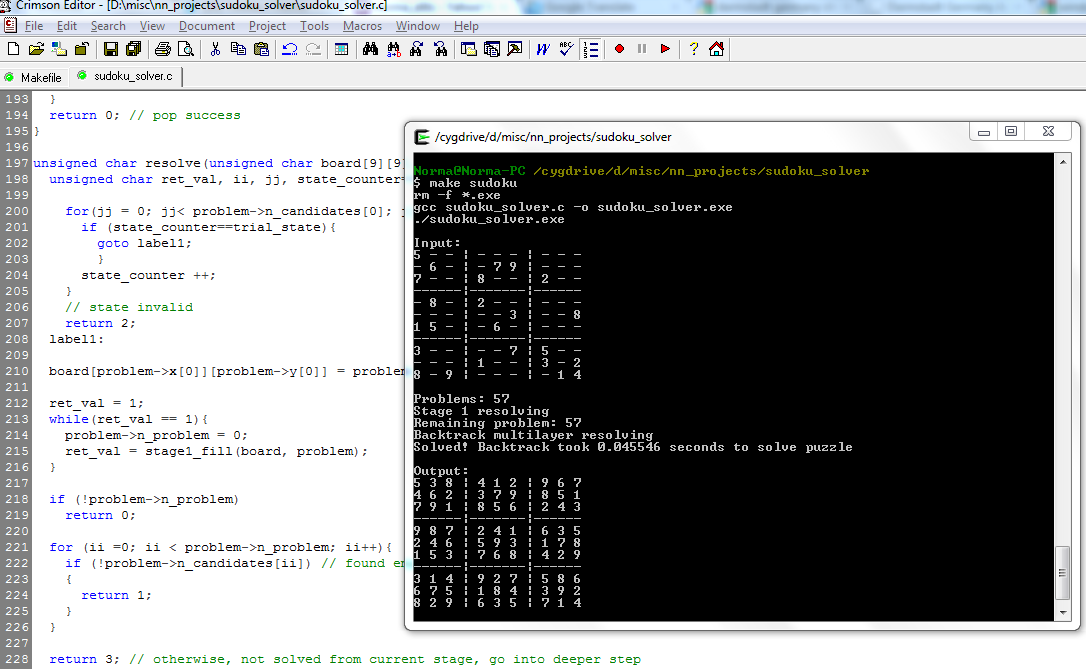
Sudoku is one of my favorite games. I used to play it a lot. One day, I meet a difficult sudoku problem that I can't solve easily, that simply perturb my mind. Rather than solving the problem, I prefer to make a solver code. I knew there are a lot of sudoku solver out there. But dude, that is the game. Creating a solver is the game itself, at least for me.
Then I did a little research. Wikipedia is always a good introductory. There are at least three methods to implement the solver:
1. Unique / Coloring / Possible Value
2. Booked Space
3. Back Track / Brute Force / Fill Empty Space

the last one is the most simple method for a practically infinite computation resource.
Ok. The solver is implemented and well tested. The screenshot shows a preview of mine.

Bellow is the C source code
link


Thursday, July 25, 2013

The Wavelet Transform


I will bookmark this tutorial for future plan.

Source:
link1
link2